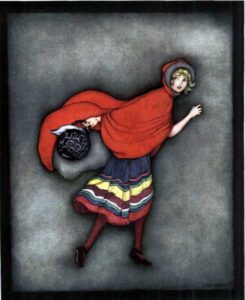
Beginning in the 1970s, authors began to return to some of the darker themes in the older versions of fairy tales. In particular, women writers began to look at the tales through feminist eyes, reevaluating the content of the tales that had been passed down and rewritten for children. Please note that the following stories deal with serious issues including violence, sexual abuse and suicide.
Read
Red Riding Hood by Anne Sexton, 1971.
In 1971, the poet Ann Sexton published a collection of poems entitled Transformations based on fairy tales. Sexton led a very troubled life, marked by abuse and bipolar disorder. Her poetry is confessional and personal. In her fairy tale poems, she moves between personal and societal commentary. As you read, note how she is using the story of Little Red Riding Hood as inspiration, rather than directly retelling it.
Angela Carter
The English writer, Angela Carter, brought a feminist lens to short stories drawn from fairy tales. In 1979, she published The Bloody Chamber, one of the first books of fairy tale adaptations of this period, and inspired many writers after her. The title story in the collection retells Bluebeard. There are three different variations based on Little Red Riding Hood included in the book. A film adaptation of one of these stories, “In the Company of Wolves,“ was released in 1984 (Angela Lansbury portrayed the grandmother!)
Watch
Read
The Werewolf by Angela Carter, 1979
Read
Riding the Red by Nalo Hopkinson, 1997
This story is found in Ellen Datlow and Terri Windling’s edited collection Black Swan, White Raven, one of many collections that the two have edited of modern works based on fairy tales and folklore. Note that these collections are an excellent source for your research project.
Nalo Hopkinson is a Jamaican-born Canadian speculative fiction writer. Of her work, she says, “I was born in Jamaica and spent most of my childhood in the Caribbean, where oral traditions of storytelling are vital. When I write, the rhythm and texture of the language are just as important to me as the meaning of the story. The words have to sing when I speak them aloud.” (Datlow, Black Swan, White Raven, 59)
These stories take a very different approach to Little Red Riding Hood; they are clearly for adults and use the story as a jumping off point. What surprised you most about these adult revisiting of Little Red Riding Hood? Why do you think the writer was drawn to Little Red Riding Hood as the inspiration for their stories?


Leave a Reply